
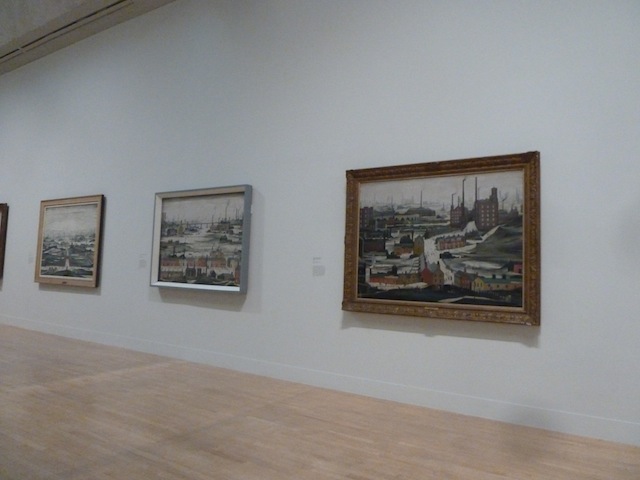
L S Lowry: Matchstalk men and matchstalk cats and dogs…
‘Now he takes his brush and he waits, outside them factory gates, to paint his…’
That was my introduction to L S Lowry, through the lyrics of flat-capped Brian & Michael on ‘Top of the Pops’ in 1978. To be honest, I haven’t given him much thought since. But as Tate Britain is currently hosting ‘Lowry and the Painting of Modern Britain’, it was a good opportunity to find out more. L S Lowry’s ‘Going to Work’ painting, cleaned and restored, is on permanent exhibition at the Imperial War Museum North in Manchester.
It’s a small exhibition and unfortunately there isn’t a great deal of information on Lowry’s own life but through his paintings it’s possible to build a picture of a man who was much more than simply a painter of ‘matchstalk cats and dogs’.
Lowry the rent-collector
To begin with we discover that he’s a man of conscience. This, in spite of his job as a rent-collector. He sees and feels things deeply, reflecting that ‘I only deal with poverty, always with gloom’. It’s true that his palette is dominated by greys and browns. But he might have countered that, since he devoted his life to portraying England through its Industrial Revolution, he painted the colours he saw. George Orwell describes it perfectly in ‘The Road to Wigan Pier’. ‘It seemed a world from which vegetation has been banished; nothing existed except smoke, shale, ice, mud, ashes and foul water.’
Then there’s the emotional gloom on Lowry’s streets of Salford and Manchester. ‘Coming from the Mill’ (1930) sees hunched factory workers. In their caps and coats, they lean into the wind against a backdrop of belching chimney stacks and an overcast sky. ‘The Auction’ (1936) depicts the sale of goods brought from the house onto the street. The viewer must ponder the reason for the sale: a death in the family? rent arrears? Some are more obvious. ‘Pit Tragedy’ (1919) clearly refers to the loss of life in the coal mine. ‘The Fever Van’ (1935) reminds us that if a child was suffering from Scarlet Fever, she might never return.
Poverty
Some context is given to the paintings with quotes from writers, artists and historians. Robert Roberts, author of ‘The Classic Slum: Salford Life in the First Quarter of the Century’ (1973) offers real insight into the lives of Lowry’s subjects. Life was hard and made worse by envy, bitterness and bad blood that could spill over in a drunken Saturday night brawl: ‘Housewives shrieked abuse at one another, interspersed with ‘case history’ examples aiming to prove to the world that the other party and its kindred were ‘low class’ or no class at all. One waved a ‘clean’ rent book (that great status symbol of the time) in the air, knowing the indicted had fallen in arrears’.
But there are glimmers of light here too. Lowry’s seaside and fairground scenes are full of life and colour, and contrast with the more familiar factory and street scenes. ‘At the Seaside’ (1946) is positively hopeful. It’s frankly amazing how much can be gleaned from characters that have been created with as few as five brush strokes.
Mitchell & Webb
A particularly moving part of the exhibition is the pieces of film, some by Mitchell and Webb, from the period. A clip of men coming from the colliery, some as black as the coal they mined, and unsure what to make of the cameraman. Colliery Workers c1912.
The final clip is of Lowry himself seen in his studio painting a matchstalk man, and a matchstalk dog. Five simple strokes to give the figure some life.
For more, from the expert, Helen Little at the Tate.
Buy a fetching flat caps in the Tate Britain shop.
Lowry and the Painting of Modern Life at Tate Britain until 20th October 2013.
For more artists, see Giorgio Morandi, Federico Fellini