

Arancino? or Arancina?
Or, ‘What’s in a name?’
by Kate Fuscoe
NOVEMBER 2025
The Diavolo is in the Detail
There’s a moment when you discover that details are important. In wine-making, they’re essential. But, apparently, elsewhere too.
I was a guest of Etna Days – the 4th edition of an event that promotes and celebrates winemaking in the Etna DOC region. The presence of other winemakers is part of the cooperation that marks out the region, with its philosophy of inter-essere or essere insieme (being together).
As different winemakers work different contrade (distinct geographical parcels of land used to cultivate traditional grapes), they can afford to share their experiences and help move the region forward as an international wine presence.
But since Italy has only been a whole country for a relatively short period, local identification remains important, and then – seemingly out of nowhere – there’s a big discussion over lunch about the correct term to be used for that tasty rice ball, the original Sicilian street food.
You say ‘Tom’ah’to’, I say ‘Tom’ay’to’
So, do you say arancino or arancina? That’s the question.
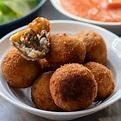
Arancini (or arancine) are, of course, the famous Sicilian rice balls that are filled with a gooey meaty ragù, or mozzarella, covered in breadcrumbs, and then deep-fried. Their history is a little uncertain, but they are likely Arabic in origin, given that the rice is often flavoured with saffron. It’s thought that the dish may once have been served as a plate of saffron rice, with the ragú in the centre, and eaten by hand. Covering the lot with breadcrumbs and deep-frying it would have made the dish more portable.
What isn’t in contention is how delicious they are. However, for Sicilians, the pronunciation remains a significant divide.
For those on the west of the island, from, say, Palermo, it’s ‘Team Arancina‘, while for those on the east, perhaps from Catania, it’s firmly ‘Team Arancino’.
Then there’s the shape.
For Team Arancina, it’s a round ball, like the orange fruit – arancia (in Italian) – that it’s named after. That seems logical.
However, for Team Arancino, the Sicilian word for ‘orange’ is masculine – arànciu. And in Sicily, the rice ‘ball’ is domed, a bit like Mount Etna. That’s also a nice local touch, though Mamma Etna (La montagna, or A fimmina, in local dialect) is ‘feminine’. Now I’m thoroughly confused, but intrigued.
Does it matter? Naturally, yes.
On a small island like Sicily, winemakers who arrived from the west to work in the Etna DOC region were once considered ‘outsiders’. And some of the bristling around the name of the golden rice ball reveals it.
My neighbour at dinner was Marco Giachino, a local winemaker, who explained that even in the next village, the dialect is distinct. When Marco saw that people from the other side of the island were coming to produce wine in his area, he thought he might have a go himself. So far, with his small winery, Vita Nova, he has produced two wines and hopes to go further this year.
The new era of Etna wines began around 20 years ago and has now grown to over 300 producers in the highly prized and protected Etna DOC area.
Marco was presenting his wines as a guest at Tenuta Tascante, one of several Tasca family properties across the island and a long-established producer (eight generations no less) of many excellent award-winning wines. A fine Carricante wine from their 2019 production was particularly notable at dinner.

Julia Monteleone and her husband, Benedetto, the winemaker, were also presenting. Former food and wine writer Julia, from Palermo, was at home in English and talked with animation about how they started with two hectares on the eastern slopes of Etna back in 2017, and how they have grown their business.
Benedetto became particularly involved when we talked about the details of winemaking, such as the ‘whole bunch’ maceration, which adds a different kind of tannin thanks to the inclusion of stems.
Julia’s more artistic bent was evident in the beautiful labelling and naming of their signature wines, such as Anthemis. A tribute to the pioneer plant Anthemis, found only on Etna, its delicate flower features on the label. The Monteleone Anthemis is a delicious, crisp 100% Carricante Etna Bianco DOC, produced on a single vineyard. I was particularly impressed that these wines are low alcohol, with whites being under 13%.
‘Island within the island’
During my visit, I heard the phrase ‘island within the island’ (referring to the different contrade within the Etna winemaking region) many times.
It seems that all of those on the island, whatever side they come from, are passionate about their wine-making, and we were lucky enough to experience their enthusiasm through the excellent wines being produced there.
It is this synergy between championing difference (arancino vs arancina), and mutual support that defined my visit.
So when those delicious rice balls are presented, just don’t get drawn into how to pronounce them. Eat, drink, and sii allegro (or is it sii allegra?)